A trial can support a useful comparison while leaving a separate question open: how closely does its population resemble the person reading about it? Those questions deserve different answers. A treatment comparison concerns what happened under particular research conditions. Applicability concerns whether those conditions, measurements and participants address a new decision.
This analysis focuses on the entry population in the original sildenafil research. We inspected relevant methods, safety and funding sections of the retained primary paper, alongside current official prescribing information. The accompanying figure describes participation. The worked examples below are original, explicitly hypothetical tools for understanding composition and uncertainty; they are not additional findings about erectile dysfunction.
Reading the evidence
- Start with the population
- Ask whom the evidence is intended to inform before interpreting a group summary.
Sources: Goldstein 1998
- Keep entry and allocation separate
- Selecting participants and assigning treatments answer different design questions.
Sources: Goldstein 1998
- Read the chart as a description
- A count of people in a category is not an estimate of the treatment effect within that category.
Sources: Goldstein 1998
- Use the right safety evidence
- A historical research result does not replace current prescribing information or an individual assessment.
Sources: Viagra label; Cialis label
- Separate product and service claims
- Evidence about a studied medication does not by itself establish the quality of a provider or a different formulation.
Sources: Goldstein 1998; FDA compounding guidance
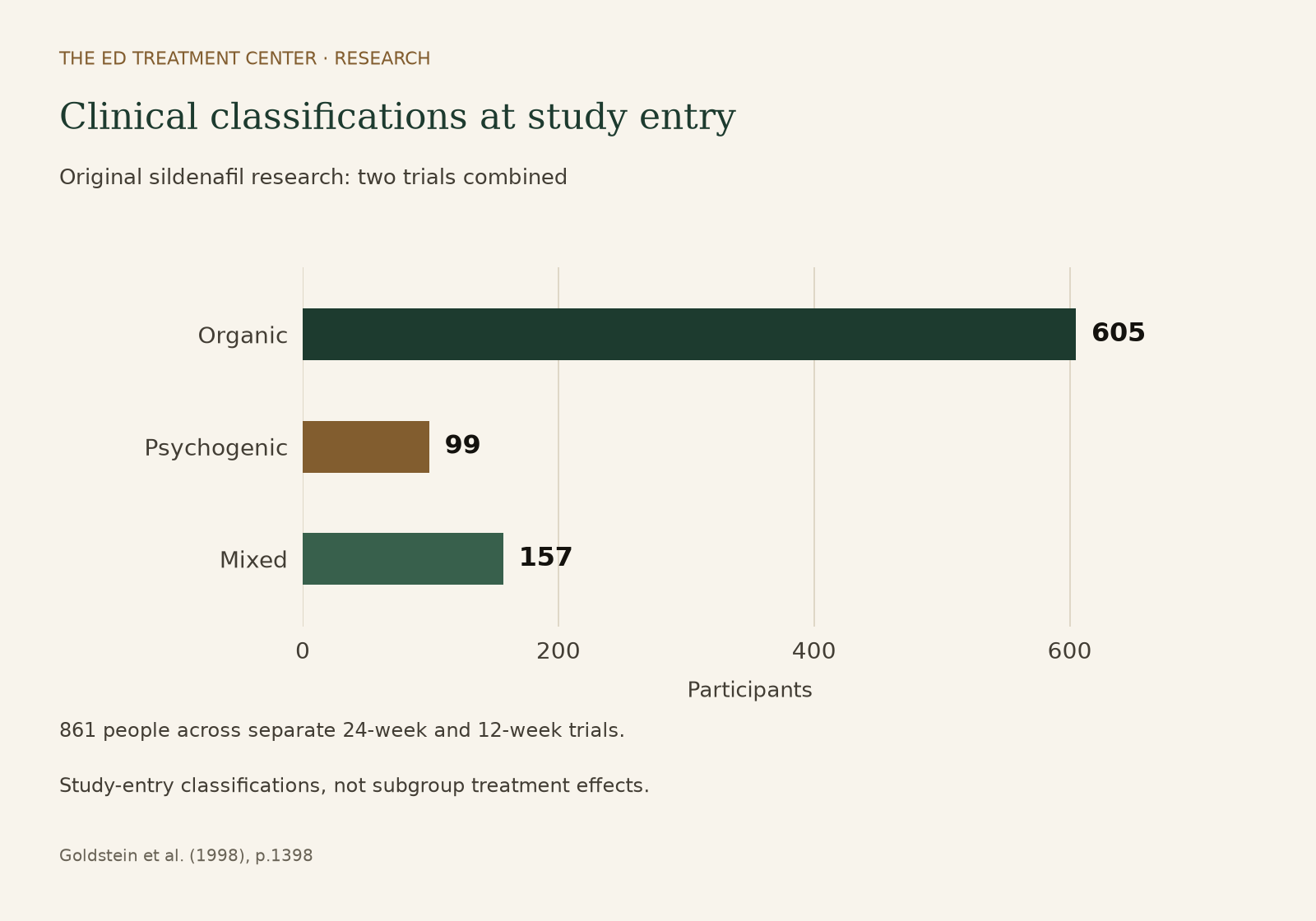
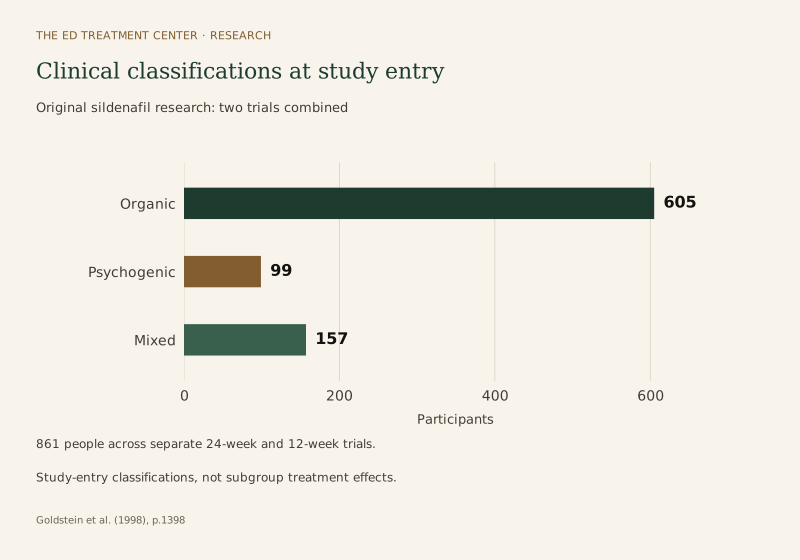
Clinical classifications at entry across two separate studies; counts are not efficacy results.
A group description does not determine individual suitability.
Sources: Goldstein 1998
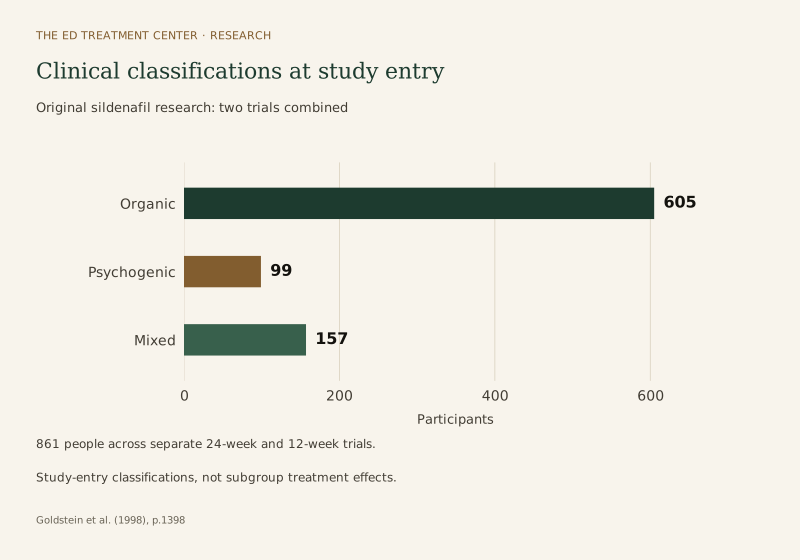
| Clinical classification | Participants | Combined population |
|---|---|---|
| Organic | 605 | 861 |
| Psychogenic | 99 | 861 |
| Mixed | 157 | 861 |
Three questions behind one study population
Goldstein’s report separates 24-week fixed-dose and 12-week flexible-dose randomized studies of oral sildenafil. Clinical assessment, not one universal test, classified participants; nitrate use and recent stroke or myocardial infarction were exclusions. Headache, flushing and dyspepsia were common in the flexible-dose study. Pfizer funded the research; consulting and company affiliations were disclosed.
Now separate three operations: recruiting people, assigning eligible participants to study groups, and applying the resulting comparison elsewhere. Random allocation can help make an internal comparison interpretable. It does not make the earlier recruitment process a random sample of everyone who might later consider treatment. The strength of one operation cannot simply be credited to another.
An original reading map therefore has three boxes: entry, comparison and intended audience. Draw an arrow between boxes only when the evidence supports that connection. For example, a well-defined allocation procedure does not establish that every relevant medical history was represented at entry. Our guide to reading ED advice online provides a place to continue that separation between a research claim and a practical decision.
Sources: Goldstein 1998
A category compresses a history
A category is useful because it compresses information. That usefulness also creates a limit: once records are compressed, differences inside a category can disappear from view. This is a property of classification, not a judgment about the legitimacy of anyone’s symptoms. A label can organize a table without becoming a complete explanation of an individual experience.
Consider an invented library example. Two patrons are both categorized as frequent borrowers. One borrows several short books each week; the other checks out a large collection once a month. The same category summarizes a shared feature while concealing different histories. To answer a question about visit frequency, the original records would matter more than the broad label.
Apply that reasoning cautiously to a clinical population table. Do not treat its labels as ranked levels of seriousness, guaranteed biological mechanisms or promises of response. Instead, ask what information produced the classification and what relevant details remain outside it. Reading why a pill may not have worked can help frame further questions; a population label itself does not diagnose the reason for a particular result.
Sources: Goldstein 1998
How composition changes an average
Here is a deliberately invented calculation using arbitrary score units. Group A has an average of 2 units and group B an average of 6. A sample containing 80 people from A and 20 from B has a combined average of (80 × 2 + 20 × 6) ÷ 100, or 2.8 units. No clinical result is represented by these numbers.
Reverse the composition to 20 people from A and 80 from B. The combined average becomes (20 × 2 + 80 × 6) ÷ 100, or 5.2 units. Both samples contain the same total number of people, and each subgroup keeps its original average. The overall figure moves because the weights move.
This example explains why a population description is scientifically relevant even when it contains no treatment outcome. It supplies context for interpreting a summary, while stopping short of telling us what the relevant subgroup results actually were. The table is an arithmetic illustration of that distinction. It does not establish that any real clinical classification has a higher or lower treatment response.
| Sample composition | Weighted calculation | Combined mean |
|---|---|---|
| 80 from A; 20 from B | (80 × 2 + 20 × 6) ÷ 100 | 2.8 units |
| 20 from A; 80 from B | (20 × 2 + 80 × 6) ÷ 100 | 5.2 units |
Sources: Goldstein 1998
Why the example cannot recalculate a treatment effect
The mixture calculation demonstrates a possibility, not an estimate for a different patient population. To reweight a real comparison, one would need the relevant outcome information within categories, corresponding information for the comparison condition, and defensible weights for the population of interest. Entry counts alone cannot supply all those ingredients.
Even a table of treated-group averages would leave a gap. A treatment effect is a comparison: the result under one condition relative to an appropriate alternative. If only one side is available, changing its weights produces another descriptive average. It does not reveal the difference attributable to treatment in the new population.
A useful annotation beside a population chart is therefore “what would be needed next?” The answer may include a cross-tabulation that was not reported, a clearer outcome definition or a target population that has not been specified. Naming that missing information is more informative than inserting a guessed correction. It also prevents a numerical example from acquiring unwarranted authority merely because the arithmetic is exact.
Sources: Goldstein 1998
A large total does not answer every small question
Sample size is a count, not a universal certificate of relevance. Imagine two invented studies with 100 records each. One contains 95 records in category A and five in B; the other contains 50 in each. The totals match, but the amount of information available for a question specifically about B does not match.
That observation still does not tell us which study has a more precise treatment estimate. Precision also depends on the outcome, its variation, the comparison and the analysis. A count alone cannot provide a confidence interval for an unobserved effect. Adding decorative uncertainty bars to a descriptive population chart would not solve that missing-information problem.
The reading task is to move from “how many people?” to “how many observations relevant to this question, measured in what way?” A common characteristic may be represented extensively while another characteristic remains poorly described. This is why a population chart and an outcome table deserve separate inspection. Neither should be asked to do the other’s job, and a reader should resist ranking medicines by the apparent size of unrelated studies.
Sources: Goldstein 1998
Entry rules and current clinical decisions have different jobs
An eligibility rule defines the boundaries of a research question. A practical participation requirement determines whether a person can follow a study process. A current contraindication identifies a clinical reason a medicine must not be used. These categories can intersect, but they are not interchangeable. Exclusion from research is not, by itself, a permanent prescription rule; inclusion is not an authorization to start treatment.
Current VIAGRA labeling contraindicates organic nitrates or nitrites and guanylate cyclase stimulators such as riociguat. It calls for assessment of underlying causes and cardiovascular status, with attention to interacting medicines. These are present prescribing-information facts, distinct from the historical study-entry description.
An original reading worksheet can preserve that distinction by placing research rules in one column and current clinical questions in another. If the columns disagree or information is missing, the worksheet should record the uncertainty rather than supply a personal decision. Our discussion of buying ED medication online safely is another reading route; it is not a substitute for the clinician who can assess an actual medical history and medication list.
Sources: Goldstein 1998; Viagra label
Keep benefit and harm in separate evidence columns
A favorable average on a benefit measure and a concern about an interaction are different propositions. One does not logically cancel the other. The useful question is not whether a single impressive statistic can settle both. It is whether the evidence addresses each proposition with the appropriate population, measurement and clinical context.
VIAGRA labeling calls for immediate care for an erection lasting over four hours. Sudden vision loss requires stopping the medicine and obtaining medical attention; sudden hearing decrease or loss requires stopping and prompt attention. Its combination with other PDE5 inhibitors or ED therapies has unestablished safety and efficacy and is not recommended. These warnings belong to current labeling, not inferred trial event rates.
For an evidence reader, this means keeping an outcome column and a safety column visible at the same time. A missing harm estimate should remain missing rather than being converted to zero. Conversely, the presence of a warning is not a numerical estimate of its frequency in a particular study. Our article on combination ED products offers related context without making the historical research a test of every combination.
Sources: Goldstein 1998; Viagra label
Participation and measurement are separate records
A study-entry count answers a membership question. An outcome analysis answers a measurement question. To see the distinction, imagine a hypothetical project with ten assigned participants and eight completed questionnaires. The assignment list contains ten names; the questionnaire file contains eight observed responses. Neither file alone explains why the other two responses are absent.
An analyst might report the observed responses, apply an explicitly stated missing-data rule, or present more than one analysis. Those choices answer related but different questions. A reader should identify the rule before interpreting the resulting denominator. It is not enough to find a convenient total elsewhere in the paper and attach it to every percentage.
The companion analysis of participant flow in the daily tadalafil trial examines that distinction from another direction. Read it as a separate example of research interpretation, not as an indirect contest between medicines. The original question here remains modest: what does the population description tell us, and what additional measurement record would be required before discussing benefit within a particular category?
Sources: Goldstein 1998; Porst 2006
A medication result is not a provider assessment
A provider name is not a treatment arm. To support a provider-level outcome claim, evidence would need to identify the service, the people receiving it, the outcome and an appropriate comparison. A medication paper does not acquire those missing observations when it is linked from a commercial page. This is an editorial inference about the scope of evidence, not a finding about any named business.
The same discipline applies to formulation claims. FDA explains that compounded drugs are not FDA-approved and do not receive its premarket review for safety, effectiveness or quality. They may meet particular medical needs. That regulatory distinction does not establish that every compound is ineffective or contaminated; it does prevent approval of a studied medicine from being silently transferred to a different preparation.
For documentary service comparisons, consult our generic sildenafil and tadalafil review and Lemonaid tadalafil review. Check the stated product, prescription process and terms in the relevant records. These links do not imply that either service reproduces the research conditions, offers an identical formulation or achieves a trial outcome. Evidence about a product and evidence about a service should remain separately labeled.
Sources: Goldstein 1998; FDA compounding guidance
Turn the paper into an answerable reading question
Begin with a sentence precise enough to expose what is unknown. “Does this result apply to everyone?” is usually too broad to guide a useful inspection. “Was the characteristic relevant to my question measured, and was an appropriate comparison reported?” identifies a concrete information need without pretending to diagnose the reader.
Then separate what is observed, what is assumed and what remains unreported. This can be done with a small worksheet rather than a long checklist. The table below is an original organizational tool, not a clinical scoring system. Its purpose is to stop a plausible interpretation from quietly becoming a stated finding.
Finally, write down the question that belongs outside the paper. A clinician may need a medical history, a medication review or other information that a population table cannot contain for an individual reader. Good scientific reading ends with a clear boundary and a better question. It does not require the reader to manufacture a personal prediction from group categories or to turn historical research procedures into instructions.
| Reading task | Record explicitly | Avoid substituting |
|---|---|---|
| Define the question | Population, outcome and comparison of interest | A broad promise of success |
| Identify the evidence | The measurement or table that addresses it | A nearby but unrelated number |
| Mark the boundary | Missing information and the next clinical question | An assumed individual result |
Sources: Goldstein 1998; Viagra label; Cialis label
Questions about the evidence
Does a category label explain why one person has symptoms?
Not by itself. A label organizes selected information, whereas an explanation must connect relevant observations to a particular question. Two records can share a label while differing in details that matter. Treat the category as an index to the underlying assessment, not as a replacement for that assessment or a prediction of response.
Sources: Goldstein 1998
Does randomization guarantee that a study represents me?
Randomization concerns how eligible participants are assigned within a study. Representation concerns the relationship between the study population and a different population of interest. Keeping those questions separate allows a reader to recognize a strong internal comparison while remaining uncertain about its applicability to an unmeasured characteristic or circumstance.
Sources: Goldstein 1998
Can I estimate a subgroup effect from the population chart?
No treatment effect follows from membership counts alone. Such an estimate would require relevant outcomes and a comparison within an appropriate analysis. The chart is useful for asking what was represented, but an empty outcome column cannot be filled by multiplying the entry counts or by borrowing an overall average.
Sources: Goldstein 1998
Should uncertain applicability make me disregard the research?
Uncertainty need not make evidence useless. It changes the claim the evidence can support. Record the part of the question the study addresses and the part it leaves open. That approach avoids treating research as either a complete personal answer or something with no value at all.
Sources: Goldstein 1998
What is useful to bring to a medical conversation?
Bring the specific research claim that prompted the question and distinguish it from your own circumstances. A concise note can identify the outcome being discussed, the population described and the information you could not find. The clinician can then assess the personal medical context; the note itself should not recommend a dose or treatment combination.
Sources: Viagra label; Cialis label
Editorial assessment
The strongest use of a population description is to sharpen the next question. It can reveal the composition of the evidence without supplying a response estimate for every person or category. Read entry, allocation, measurement and present-day applicability as distinct steps. Our original arithmetic examples show why those distinctions matter, but they do not modify the published results. A careful reader can value the research while declining to infer an individual outcome, a preferred provider or a current prescription from information the population chart does not contain.
Sources and access
- Oral sildenafil in the treatment of erectile dysfunction. Sildenafil Study Group.
Methods, results and funding passages inspected in retained full-text primary articles.
Checked 2026-10-25.
- Evaluation of the efficacy and safety of once-a-day dosing of tadalafil 5mg and 10mg in the treatment of erectile dysfunction: results of a multicenter, randomized, double-blind, placebo-controlled trial.
Methods, results and funding passages inspected in retained full-text primary articles.
Checked 2026-10-25.
- VIAGRA (sildenafil citrate) US prescribing information
Official prescribing information inspected.
Checked 2026-10-25.
- Cialis (tadalafil) prescribing information
Official prescribing information inspected.
Checked 2026-10-25.
- Understanding the risks of compounded drugs
Official FDA guidance inspected.
Checked 2026-10-25.
Important
The information on this website is provided for general education and does not constitute medical advice, diagnosis, or treatment. Erectile dysfunction can be the first sign of cardiovascular disease, diabetes, or hormonal disorders. Always consult a licensed physician about your individual circumstances, and never start, stop, or change a prescription based on what you read here.